
The answer applies to all electronic dimmers, of any make or model.
An electronic dimmer is an electronic device that allows you to continuously vary the power supplied to an electrical load (lights, motors, heating) without significant energy losses.
Dimmax are dimmers designed exclusively to control lighting intensity, for single-phase 230V AC 50 Hz lighting systems declared dimmable.
Between dimmer output and 230 V neutral. If there are several lighting systems or lamps, they must all be identical and parallel.
Not all lamps are linear and dim between 0-100%.
For example, some lamps only come on from a setpoint of 25% and are already at the maximum perceived light value of 80%. These lamps therefore operate in a smaller dimming range.
By setting the minimum value, curve type and dimming type, you can already improve the perception of dimming.
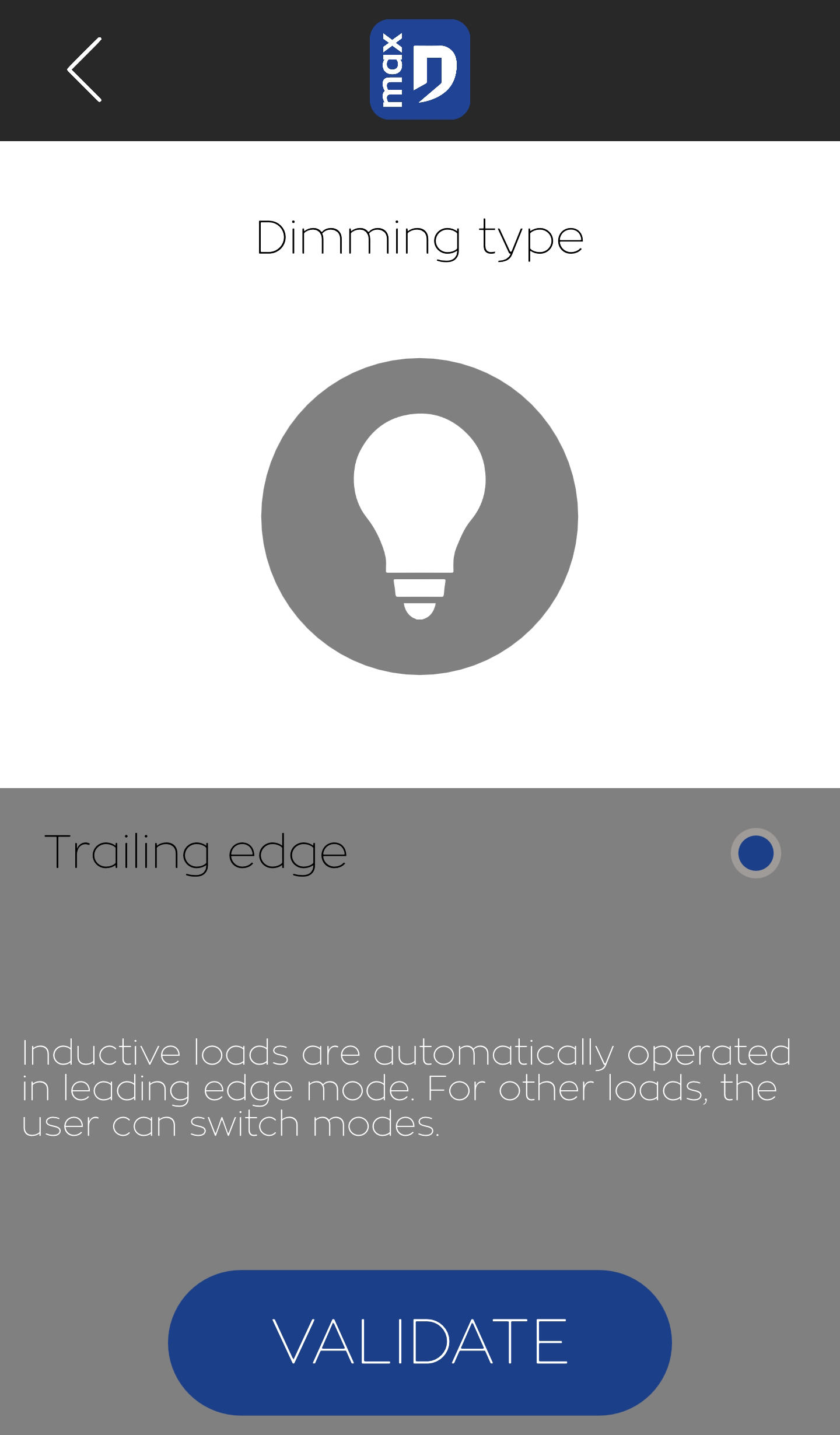
Lamps can be dimmed on rising or falling edges.
Trailing edge dimming, for use with :
- Classic 230 V lamps (bulbs or halogens): best mode for cold start, power 0-420 W
- Electronic converters or dimmable 230 V LEDs compatible with trailing edge, power 0 - up to 200 VA
Leading edge dimming, also known as "triac mode", for use with :
- Wound transformers for 12 V halogens (the module detects them and imposes this type of dimming), power 0-380 VA
- Dimmable 230 V electronic converters or LEDs compatible with leading edge, power 0 - up to 200 VA
The user can safely try out each type of dimming to find the best compromise. If an inductive load is detected, the dimmer systematically refuses to change mode.
Depending on the manufacturing technology, each LED behaves differently. The main factor is start-up current. Even if an LED consumes little power, it can induce strong current peaks during start-up. The maximum permissible power therefore depends on these start-up currents, which can only be measured during tests.
When tests are not possible, the user can gradually increase the number of LEDs until the module goes into protection.
Dimmable LEDs of varying quality are available on the market. Their design changes rapidly, even for similar models from the same manufacturer. Some, even when declared dimmable, offer only a limited dimming range, and/or can cause huge transient current peaks.
Given the current absence of international quality standards, it is impossible to guarantee that all models on the market will perform correctly up to a maximum of 200 VA, but this is frequently the case.
If in doubt, Dmax recommends contacting your local distributor BEFORE purchasing LEDs. You can always try low-quality LEDs, but the module will remain protected.
In the minimum value setting, the user must increase the output value until the lamp lights up without flickering. If the value is exceeded, you'll have to start again.
Each time the window opens, the minimum value must be set again.
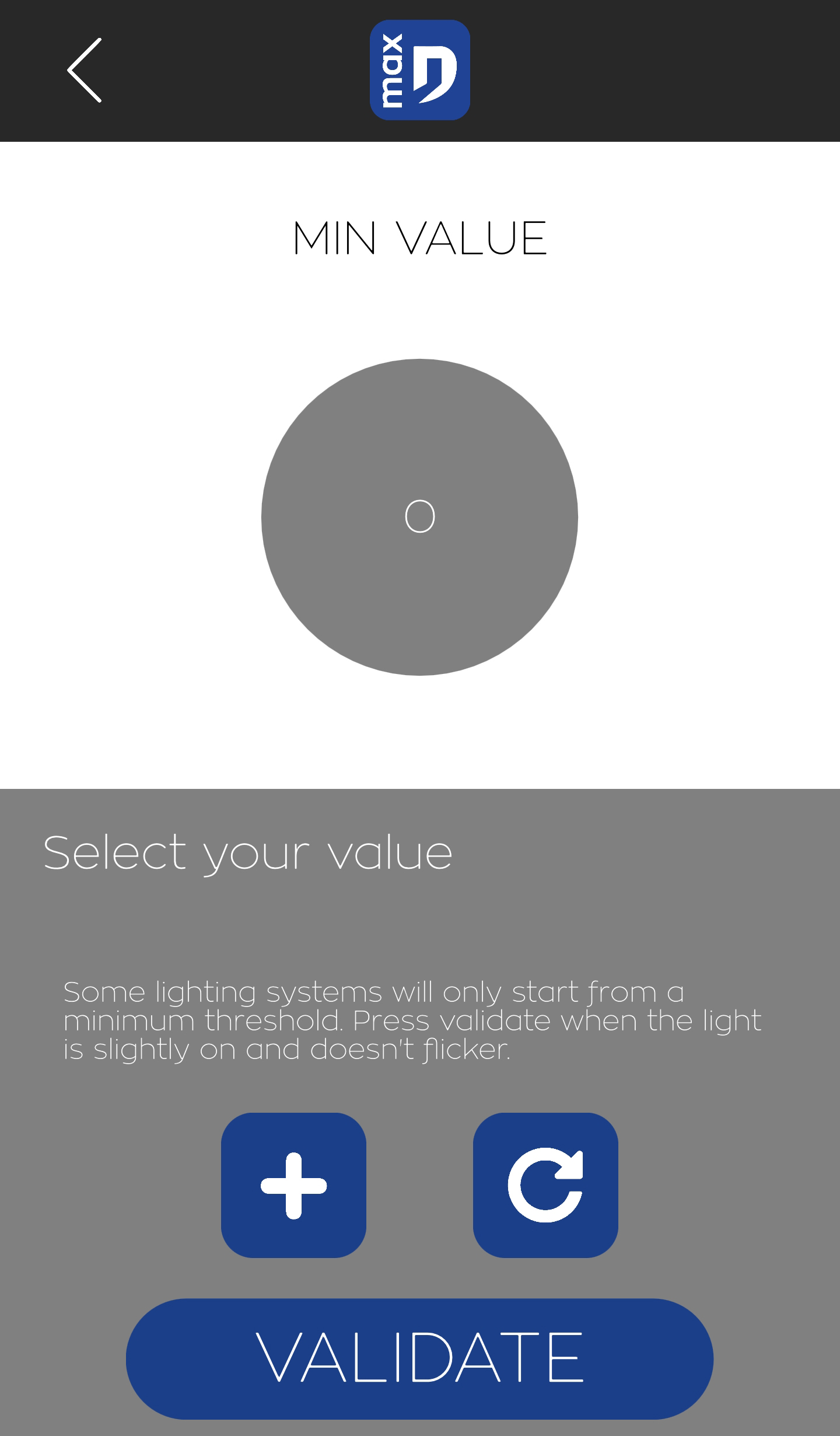
Make sure you have correctly set the minimum value, dimming type and dimming curves.
If problems persist, contact technical support.
Push button :
When the button is PRESSED FOR A LONG TIME (> 0.4s): the dimmer turns on (if it was off) and the dimming rate rises/falls slowly between Min (adjustable) and Max (100% = total conduction) levels; the last level is retained when the button is released.
For a SHORT PUSH (<0.4s) on the button: the dimmer turns on or smoothly turns off.
Application:
Long press: A long press on the module icon opens a popup with a circle. Without releasing, point your finger at the center of the circle. A circle appears with a dimming level in the center. Moving away from the center increases the value, moving closer decreases it. 0 corresponds to the minimum value and 100 corresponds to the maximum value that the user configures with the dimming curves.
To return, simply release.
Short press: similar behavior to push-button.
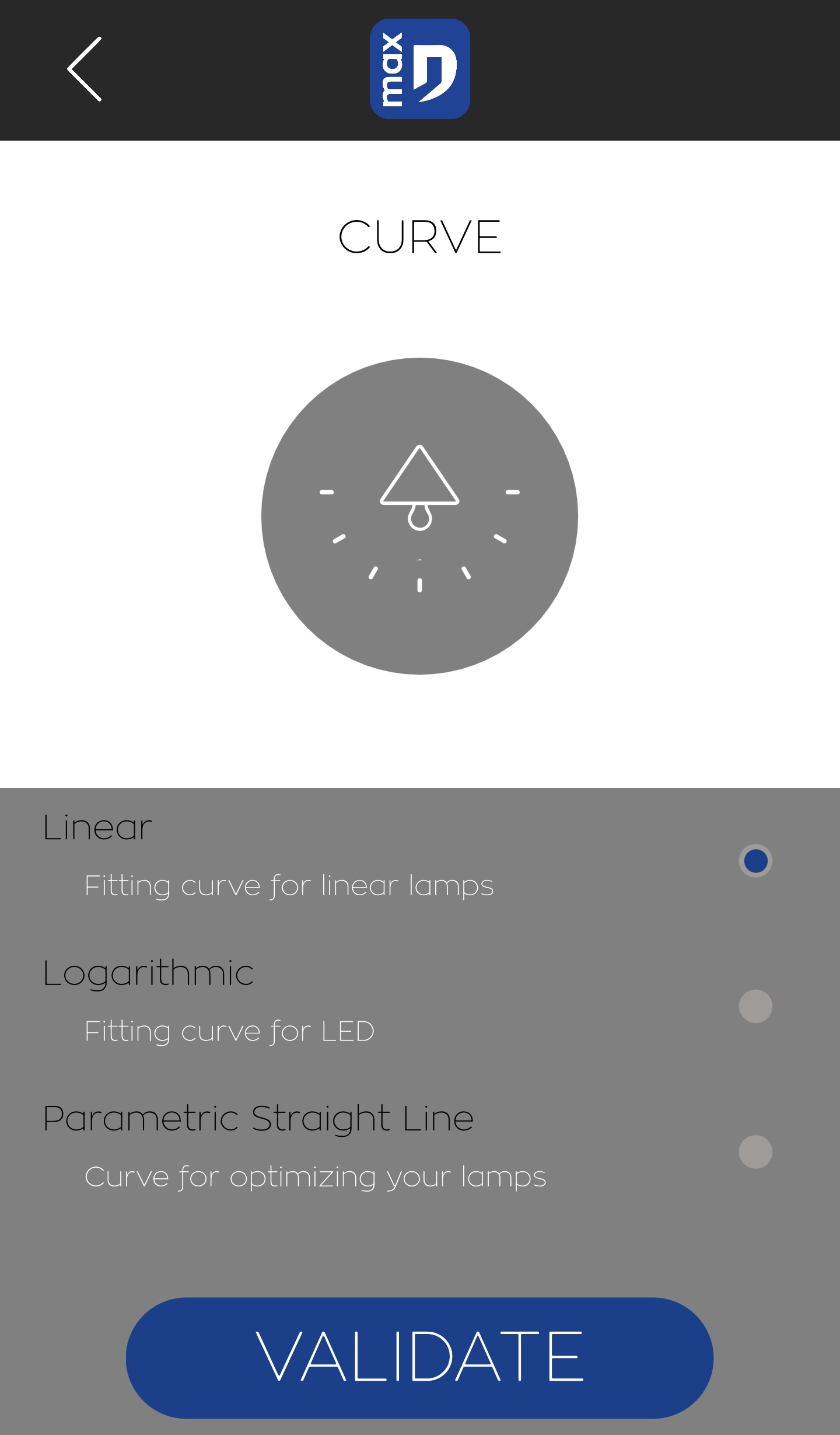
3 curves are available: logarithmic, linear and straight parametric.
The logarithmic curve: for lamps that light up very quickly at their maximum level. When a lamp is at its maximum at 45%, for example, it's best to optimize the dimming experience by working logarithmically. In this way, the dimmer concentrates mainly on the beginning of its range.
The linear curve: corresponds to lamps that dim correctly from the outset and don't need to be optimized.
Parametric line: lamps that are linear but not wide-range can be optimized with this line. The user selects the minimum and maximum value of perceived light. In this way, the user determines that an Alpha Lamp starts to light up at X% and reaches its maximum at Y%. When the light intensity is changed, the dimmer moves from X% to Y%, ignoring values outside the range.
How do I configure the linear parametric curve?
You need to set the minimum value again because the lamp is faulty at a low dimming value → raise the minimum value above this value.
The Dimmax is constantly monitored by its processor. If an error occurs, the processor triggers a protective action.
Overcurrent occurs when a transient current higher than the permitted limit has occurred. The dimmer switches off immediately and the push-button is deactivated for 1 minute;
After 1 minute, the module can be reactivated using the push-button.
Overtemperature occurs when the internal temperature exceeds the permitted limit. The dimmer gently switches off and the push-button is deactivated until the internal temperature drops below half; when the temperature drops, the device automatically recovers its last level.
Basically, NO. Dimmax are dimmers for single-phase loads.
NEVER. Use a more powerful Dimmax.
Yes. Connect them all in parallel
NO. The current used in the button link is very small, and incapable of lighting up a luminous indicator.
If the Dimmax devices do not share the same phase and neutral, this is totally forbidden.
If they share the same phase and neutral, you won't have any electrical problems, but this is not recommended.
After several dimming operations, the dimming levels of the different Dimmaxes will slowly differentiate, as each operates on its own internal processor clock, and there is no synchronization between them.
When the Dimmax is disconnected, the memo is lost.
There's only one way to change the Dimmax memo value: set the value to another level (with long presses), then switch it off (with a short press). The value will be reassigned.
In either case, the light will go out.
If slow or at a reduced value of 30%, overheating has occurred. If extinction is instantaneous, overcurrent has occurred.
For Overtemperature:
- Check that the environment is not too hot, and correct if necessary
- Then, after waiting for the dimmer to cool down, it will restart.
- If this happens repeatedly during installation, change the operating mode.
If unresolved, reduce load power
For Overcurrent:
- check that no wires or lamps have short-circuited (some lamps short-circuit by "jumping")
- You'll then be asked to wait before restarting manually, to let you know that you have a check to do!